
Quick comparison
Top picks at a glance
| Product | Best For | Rating | Price | |
|---|---|---|---|---|
| UGREEN Nexode Power Bank 20K 130W | Best overall laptop power bank | $89 | Check Price | |
| Anker Prime Power Bank 27,650mAh | Best premium high-output option | $180 | Check Price | |
| Baseus Blade HD 20K | Best slim travel profile | $99 | Check Price | |
| INIU PowerNova 27K 140W | Best value for bigger batteries | $109 | Check Price | |
| Shargeek Storm2 Slim | Best for enthusiasts | $149 | Check Price | |
| Zendure SuperMini GO | Best ultracompact emergency laptop backup | $79 | Check Price |
Laptop power banks are one of the most misunderstood product categories in portable tech. A lot of batteries claim laptop compatibility because they can physically connect to a USB-C laptop and move the battery percentage upward under ideal conditions. That is not the same as being useful. The real test is whether a power bank can sustain meaningful output while the laptop is awake, doing actual work, and being used in the sort of bursty sessions that happen during travel. If a battery only helps when your machine is asleep in a bag, it is not solving the problem most buyers have in mind.
That is why I use a stricter definition here. A good laptop power bank should do one of three things well: hold charge steady during lighter workloads, provide a meaningful top-up between meetings or flights, or extend the workday enough to let you skip outlet hunting. It does not need to fully replace a wall charger. It does need to provide value in motion.
The UGREEN Nexode Power Bank 20K 130W is the best overall pick because it hits that standard without becoming absurdly expensive or oversized. If you need the most performance and do not mind paying for it, the Anker Prime 27,650mAh is the premium option. If carry profile matters more than peak bragging rights, the Baseus Blade HD 20K is easier to pack than most high-output rivals.
One thing buyers consistently underestimate is recharge discipline. A larger battery that is slow or annoying to recharge becomes less reliable precisely when you need it. That is why I favor packs that are easy to top up overnight or between meetings rather than just those with the highest raw capacity. Real utility comes from cycles, not theoretical maximums.
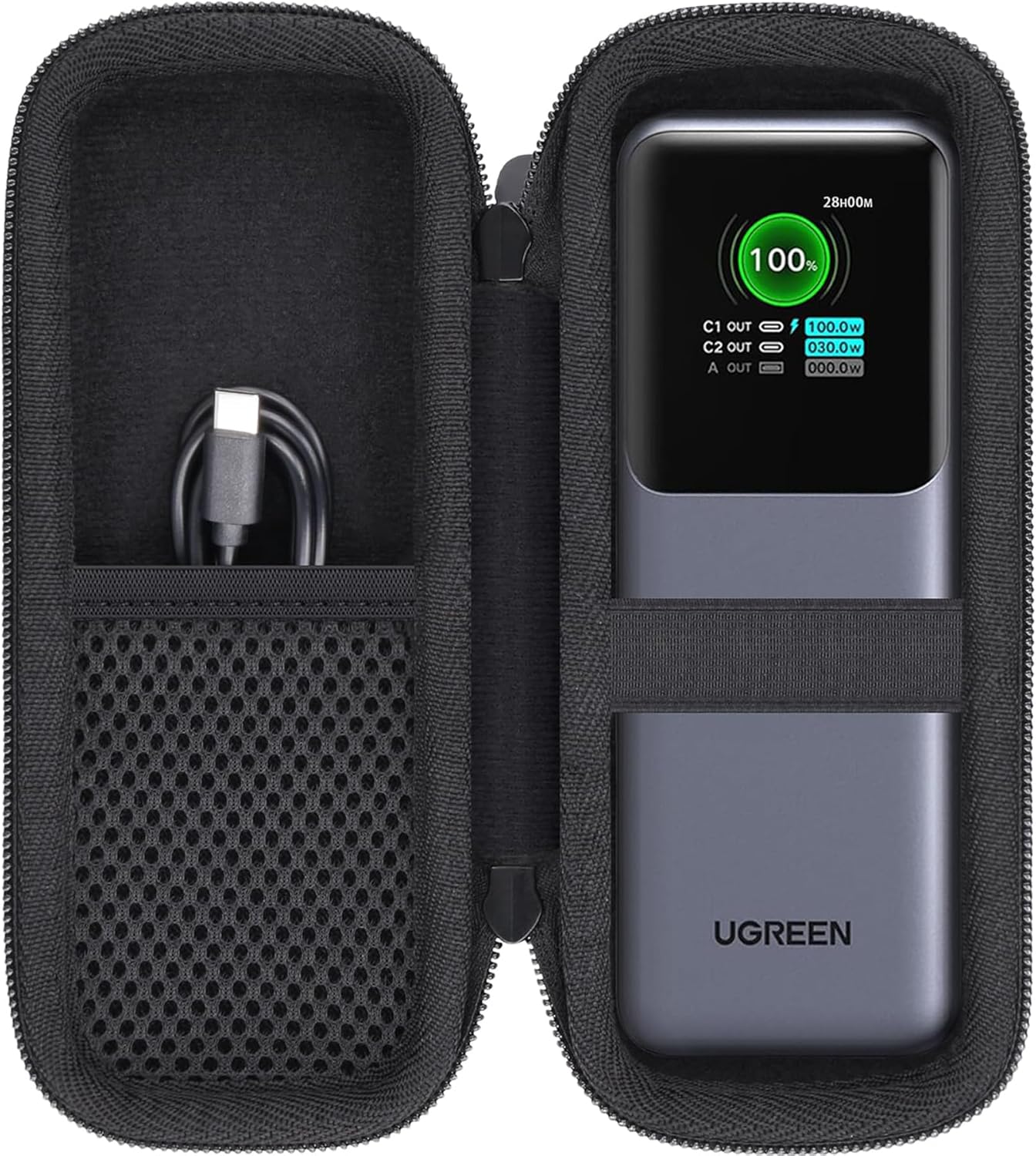
Best Overall: UGREEN Nexode Power Bank 20K 130W
The UGREEN Nexode is the battery I would recommend to most readers who want one product that can credibly support a USB-C laptop and still feel travel-friendly. The capacity is enough to matter, the output is high enough to support modern ultraportables and tablets, and the footprint stays within reason for backpacks and larger slings. It feels like a product designed for actual mobile work rather than spec-sheet marketing.
What I like most is that the Nexode avoids the all-or-nothing trap. It is not so small that it becomes borderline useless for laptops, and not so large that you dread carrying it. For MacBook Air-class machines, compact Windows ultrabooks, and travel-heavy workflows, it offers a sensible balance. It is also flexible enough to charge phones, headphones, and handhelds well, which matters when your battery pack needs to cover more than one device.
Pros
- Strong real-world output for common USB-C laptops
- Good balance of capacity and portability
- Useful display and port layout
Cons
- Still heavy compared with phone-first batteries
- Not inexpensive
- Overkill if you only need phone charging
Best Premium Option: Anker Prime Power Bank 27,650mAh
The Anker Prime is what happens when a company builds a laptop power bank for people who are tired of compromises. It is powerful, dense, and equipped with enough intelligence and output to support demanding use cases better than most competitors. If you routinely travel with a laptop, tablet, phone, and maybe even a portable monitor, this class of battery starts to make sense.
The problem is obvious: it is expensive. Very expensive for a battery pack. That means the Anker Prime is less a universal recommendation and more a precision pick for users who will actively use its strengths. For consultants, field workers, creators, or frequent travelers who genuinely live off USB-C power, the premium is easier to defend. For occasional laptop users, it is hard to justify.
Pros
- Excellent output and capacity for serious mobile workflows
- Premium build and interface
- Capable enough to anchor a multi-device travel kit
Cons
- Very expensive
- Heavier than moderate users need
- A niche buy for power users rather than everyone else
Best Slim Travel Shape: Baseus Blade HD 20K
The Baseus Blade HD earns its place because shape matters. Many laptop batteries are compact in one dimension and awkward in another, which makes them harder to fit into laptop sleeves or flatter tech compartments. The Blade style solves that. It is flatter and more packable, which makes it easier to carry alongside a laptop instead of as a separate chunky object.
Performance is still solid. It will not outmuscle the most aggressive premium packs, but it provides meaningful support for lightweight laptops and works well for people who value form factor almost as much as wattage. That makes it a strong recommendation for airline travelers and commuters using slimmer bags.
I also think flat battery designs pair better with modern mobile work habits. More people are carrying their laptops in vertical backpack sleeves or brief-style compartments, not giant gear bags. A flatter battery is easier to slide next to that hardware without creating a pressure point or bulge, and that packability advantage becomes obvious fast if you travel every week.
Pros
- Flat design packs well next to a laptop
- Good travel ergonomics for slimmer bags
- Enough output for meaningful ultraportable support
Cons
- Less comfortable to hold as a handheld charger
- Not the absolute highest-output option
- Shape is excellent in bags but less versatile on the go
Best Value Large Battery: INIU PowerNova 27K 140W
The INIU PowerNova 27K is the value-focused answer for buyers who want real laptop support without entering Anker Prime pricing. It is still a substantial battery, but the output and capacity are strong for the money. This is the kind of product that makes sense if you travel frequently with a work laptop and want to maximize runtime per dollar.
The main compromise is polish. It feels more functional than refined, and the overall experience is less premium than the best high-end competitors. For many buyers, that does not matter. If the battery delivers where it counts, cosmetic refinement is secondary. The PowerNova gets enough of the fundamentals right to be a smart buy.
Pros
- Very good value at this capacity and wattage
- Meaningful support for laptop-first travel
- Strong choice for pragmatic buyers
Cons
- Bulk is unavoidable
- Fit and finish trail premium rivals
- Still more battery than casual users need
Best for Gear Enthusiasts: Shargeek Storm2 Slim
The Storm2 Slim is not the most rational buy in this category, but it is one of the most enjoyable for enthusiasts. The transparent design and detailed display create a level of charging visibility that appeals to people who care about exactly what their gear is doing. That kind of visibility is not necessary, but it can be genuinely useful when troubleshooting a mixed-device travel setup.
The issue is that a more straightforward battery can often do the core job for less money. So the Storm2 Slim is best understood as an enthusiast product: satisfying, distinctive, and slightly indulgent. If you know that is what you are buying, it is a good one.
Pros
- Distinctive design and excellent charging telemetry
- Appeals to users who want more insight into power behavior
- Still delivers solid laptop-capable output
Cons
- Pricey for the practical performance
- Less discreet than conventional battery designs
- More enthusiast-oriented than strictly necessary
Best Emergency Laptop Backup: Zendure SuperMini GO
There is a place for a compact battery that is not a full laptop solution but can still buy you time. The Zendure SuperMini GO fits that role. It is small enough that carrying it is easy, which means it is more likely to be with you. For users who mostly need an emergency meeting saver rather than a full mobile workstation battery, that can be the smarter choice.
I would not buy this expecting it to meaningfully power demanding laptop sessions. That is not the point. The point is having a small, credible fallback when your day runs longer than planned. For some readers, that is the most realistic scenario anyway.
There is a broader lesson there. The best laptop power bank is not always the largest one you can tolerate. It is the one you will actually bring. For some users, that means a middleweight battery with legitimate output. For others, it means an emergency-focused compact pack that still fits in a daily backpack without argument. Your real carry habits matter more than your aspirational ones.
Pros
- Easy to carry compared with large laptop batteries
- Good emergency top-up option
- More practical for light users than a giant brick
Cons
- Limited usefulness under sustained laptop loads
- Not a replacement for higher-capacity models
- Best understood as backup, not primary power
How we tested
I focused on three questions. First, can the battery support a laptop that is awake and doing real work? Second, does the size and weight make sense for the type of travel where someone would need it? Third, does the pack offer enough versatility to justify its footprint in a broader carry kit? I used typical mobile workloads as the reference point: browser tabs, writing, calls, light editing, charging a phone alongside a laptop, and repeated plug-unplug cycles throughout the day.
That testing quickly separates true laptop-capable batteries from the ones that are technically compatible but operationally underwhelming. A power bank that only works well in carefully managed conditions is not worth recommending here.
Buying guide: choosing a laptop power bank
The first thing to check is your laptop’s charging behavior. Thin-and-light machines are far easier to support than performance laptops. If your device normally ships with a 30W to 65W charger, you have more options. If it expects higher sustained wattage, battery support becomes more situational.
Second, decide whether you need runtime extension or emergency insurance. Runtime extension requires a larger, higher-output battery and more willingness to carry weight. Emergency insurance can be handled by a smaller pack that simply keeps you alive long enough to finish a meeting or board a flight. Buyers often confuse these two use cases and end up unhappy with otherwise decent products.
Third, think about your cable. A laptop-capable battery deserves a cable that can deliver the power cleanly. If your current cable assortment is a drawer of random USB-C cords, fix that before blaming the battery. Our USB-C cable guide is a good place to start.
Finally, consider where you will use the battery most. If it mainly lives in a backpack, weight is easier to tolerate and larger packs become more attractive. If you move through events, airports, and trains with lighter carry, size and shape matter a lot more. In practice, most people benefit from respecting their bag first and their spec sheet second.
FAQ
Can a power bank replace my laptop charger?
Usually not for long stretches. The best laptop power banks are most useful for topping up, extending runtime, or keeping a laptop stable during lighter workloads away from outlets.
Is 20,000mAh enough for a laptop?
For many ultraportables, yes, if your expectations are realistic. It can provide a meaningful boost or partial recharge. It is less convincing for larger or more power-hungry laptops.
Why do some laptop power banks feel disappointing?
Because “compatible” does not always mean “useful.” Output limits, energy losses, and real-world workloads all affect how much help a battery can provide.
Should I buy the biggest battery allowed?
Only if you will truly use it. The largest batteries deliver the most power, but they also add the most weight and bulk. Many travelers are better served by a balanced 20K-class unit.