
Quick comparison
Top picks at a glance
| Product | Best For | Rating | Price | |
|---|---|---|---|---|
| Anker Nano Power Bank 10K | Best overall travel charger | $49 | Check Price | |
| UGREEN Nexode Power Bank 20K 130W | Best for laptop backup | $89 | Check Price | |
| Baseus Magnetic Mini 6K | Best MagSafe-style option | $39 | Check Price | |
| Nitecore NB10000 Gen 3 | Best ultralight pick | $60 | Check Price | |
| INIU B63 25K Power Bank | Best high-capacity value | $69 | Check Price | |
| Sharge CarbonMag 10K | Best premium design | $79 | Check Price | |
| Goal Zero Flip 24 | Best simple backup battery | $29 | Check Price |
Travel is where a battery pack stops being a nice accessory and becomes infrastructure. If your phone is your boarding pass, your camera, your translator, and your backup work device, dead battery anxiety changes how you move through a trip. It affects whether you stop to navigate, whether you take photos, and whether you confidently work from a train seat or airport lounge. A good travel charger should disappear into your setup until you need it. A bad one makes your bag heavier, your cables messier, and your charging plan less reliable.
For this guide, I focused on portable chargers that make sense for real carry, not spec-sheet theater. That meant paying attention to thickness, port layout, recharge speed, heat under sustained use, and whether a battery still felt worth carrying after a week of flights and commuting. The best packs are not necessarily the biggest. They are the ones that solve the most common travel problem with the fewest tradeoffs.
If you already know your use case, here is the short version. The Anker Nano Power Bank 10K is the easiest recommendation for most travelers because it nails the fundamentals: good size, solid efficiency, dependable USB-C charging, and no weird ergonomics. If you need laptop support, the UGREEN Nexode Power Bank 20K 130W is the better tool. If weight matters more than raw output, the Nitecore NB10000 Gen 3 stays hard to beat. And if your setup is mostly iPhone plus AirPods, a magnetic pack like the Baseus Magnetic Mini 6K is much more useful than a heavier brick.
Best Overall: Anker Nano Power Bank 10K
The Anker Nano Power Bank 10K is the battery pack I would hand to the broadest range of travelers without a long explanation. It is small enough to justify carrying every day, but still powerful enough to refill a modern phone close to two times or bail out smaller devices like earbuds and compact tablets. More important, it feels balanced. The shell is sturdy without being slippery, the USB-C behavior is predictable, and the recharge time is reasonable enough that it does not become another thing you have to babysit in the hotel room.
In daily use, the Nano hits the sweet spot between “backup battery” and “real travel tool.” It can cover a full delay-heavy airport day, a convention floor, or a long city-walking itinerary without forcing you into a giant 20,000mAh slab. That matters because the best power bank is often the one that is actually in your bag when you need it. A lot of bigger packs win on capacity but lose on carry friction.
Pros
- Excellent size-to-capacity ratio for everyday travel
- Reliable USB-C charging with no odd compatibility issues
- Easy to fit into small slings, pouches, and seat-back pockets
Cons
- Not enough output for serious laptop charging
- No integrated display for remaining runtime
- Price is slightly above the bargain tier
Best for Laptop Backup: UGREEN Nexode Power Bank 20K 130W
The phrase “laptop power bank” gets abused. Plenty of batteries can technically charge a laptop if the machine is asleep, half-charged, and not doing anything demanding. The UGREEN Nexode 20K 130W is one of the better options because it can deliver the sort of sustained USB-C power that makes a real difference during work travel. For a 13-inch laptop, it is enough to hold battery percentage steady during light work or add meaningful runtime when you plug in during a break.
This is not a minimalist carry item. It is heavier and thicker than a 10K travel battery, and you notice it if your bag is already dense. But the tradeoff is justified for people who work from airport gates, trains, or conferences where outlets are scarce and desk time is fragmented. The screen is also useful. I do not think every battery pack needs a display, but on higher-output units it helps to confirm charging speed and remaining headroom instead of guessing.
Pros
- Enough output to be legitimately useful with USB-C laptops
- Good port mix for charging multiple devices
- Display adds real utility instead of gimmick value
Cons
- Heavier than casual travelers will want
- Overkill if you only charge a phone and earbuds
- Takes up meaningful pouch space
Best Magnetic Option: Baseus Magnetic Mini 6K
Magnetic battery packs make sense when you value simplicity over efficiency. They are less space-efficient than a cable-first power bank and typically slower, but the convenience is real. The Baseus Magnetic Mini 6K works because it stays compact enough to feel phone-like instead of brick-like. It is better for top-ups than full rescues, but that is exactly how many travelers use a magnetic pack: keeping maps, messaging, and music alive while walking through a city or waiting out a delay.
The key with magnetic packs is honesty about expectations. If you are trying to maximize watt-hours per ounce, buy a wired USB-C battery instead. If you want a charger that takes almost no thought and is pleasant to use with a single phone-centric setup, this style wins. I especially like it for quick trips where your carry system is a jacket pocket, small sling, or compact personal-item bag.
Pros
- Very convenient for phone-first travel setups
- Slim enough to stay usable while attached
- Easy recommendation for short-haul trips and commuter kits
Cons
- Lower efficiency than wired charging
- Limited capacity compared with similarly sized cable-based packs
- Can get warm during prolonged wireless charging
Best Ultralight Pick: Nitecore NB10000 Gen 3
The Nitecore NB10000 remains a favorite among weight-conscious travelers for a reason. It is not the cheapest 10,000mAh pack and it does not try to be the most feature-rich, but the weight savings are real. If you build your bag carefully, this is one of those products that changes what you are willing to carry every day. It is especially compelling for travelers who already optimize around pack weight, whether that means one-bag travel, hiking-heavy itineraries, or simply avoiding shoulder fatigue during long conference days.
There is also a psychological advantage to ultralight gear: it lowers the threshold for carrying backups. A heavier battery often gets cut from the loadout when space gets tight. The NB10000 tends to stay in the bag because it does not feel like a penalty. That said, it is a specialist recommendation. You are paying extra for weight reduction, and if your budget matters more than every saved ounce, mainstream alternatives give you more value.
Pros
- Outstanding weight for the capacity
- Slim shape works well in organizer pockets and small pouches
- A strong pick for minimalist or one-bag travel
Cons
- More expensive than standard 10K batteries
- No premium extras like a display or integrated cable
- Shell feel is functional rather than luxurious
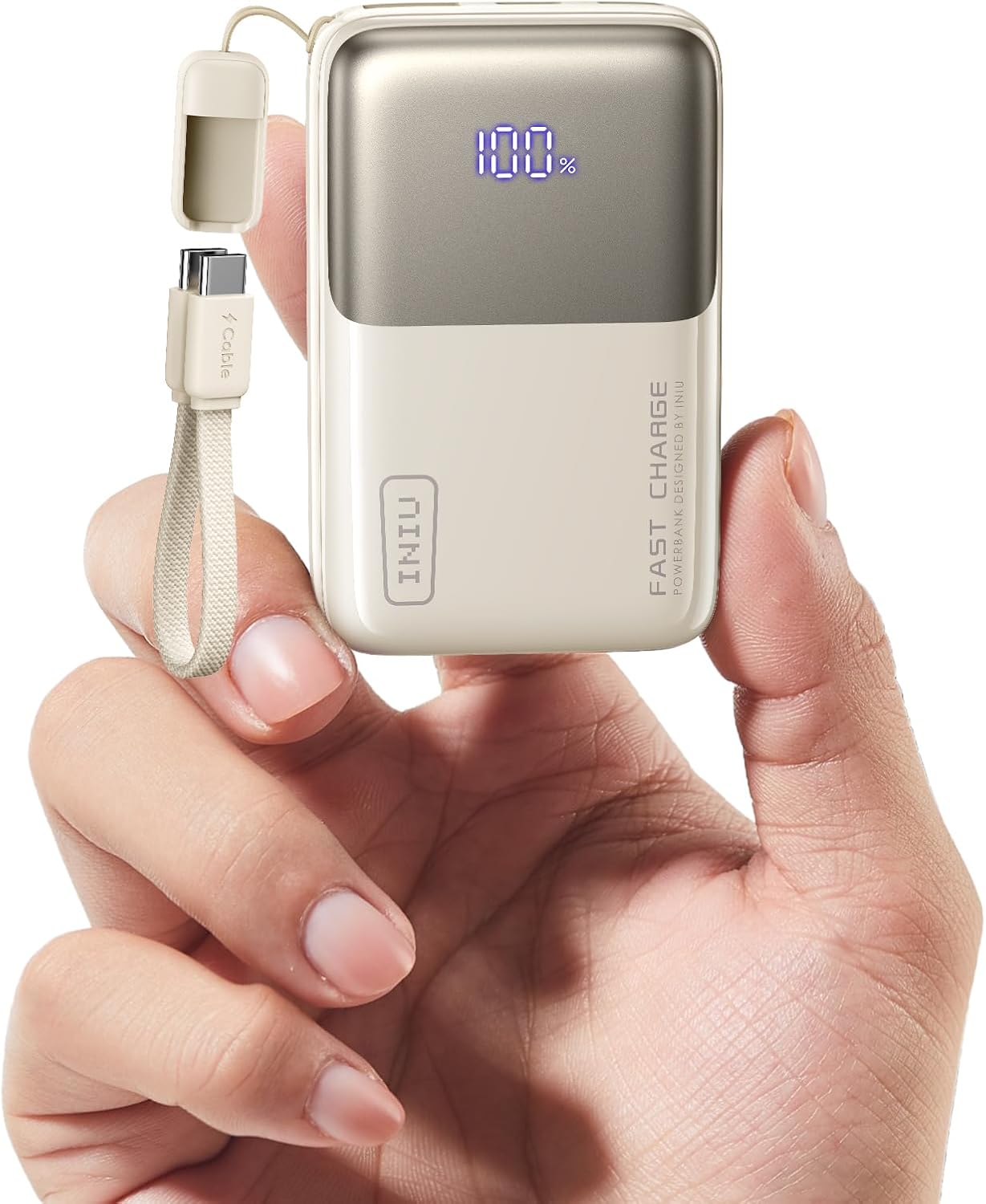
Best High-Capacity Value: INIU B63 25K Power Bank
The INIU B63 25K is the kind of battery I recommend to families, heavier device users, or travelers who know they routinely carry two or three things that all need power. It is not elegant, but it is practical. The capacity gives you room to be imperfect. You can charge a phone, top off a tablet, and still have enough reserve left for the next leg of the day. That margin matters more than headline wattage for some travelers.
I would not choose this for a compact sling or a tightly curated EDC setup. The physical size pushes it toward backpack travel. But if your priority is fewer charging interruptions and better value per charge cycle, it makes sense. This is also a nice option for road trips and shared-device scenarios where one battery has to support multiple people.
Pros
- Excellent value for the capacity and output
- Useful for multi-device travelers and families
- More forgiving if you forget to recharge every night
Cons
- Too bulky for minimalist carry
- Feels utilitarian rather than refined
- Not the best fit for travelers obsessed with weight
Best Premium Design: Sharge CarbonMag 10K
The Sharge CarbonMag is the sort of battery pack that gets attention because it looks like someone actually cared about the industrial design. That can sound superficial, but design matters on accessories you handle constantly. This pack feels slim, modern, and thoughtfully finished. For people who care about how their gear set works visually as well as functionally, that has value.
The catch is that you are paying a premium for the experience. It is not bad value if you appreciate the thin profile and nicer materials, but it is harder to justify on pure performance. If your goal is utility per dollar, buy the Anker or Nitecore. If you want your charger to feel like a deliberate part of a premium carry kit, the Sharge is the more satisfying object.
Pros
- Excellent industrial design and pocket feel
- Thin profile works well in premium travel kits
- Good option for style-conscious minimalist carry
Cons
- Price premium is obvious
- Performance advantage over cheaper rivals is modest
- Better as a personal indulgence than a value buy
Best Simple Backup: Goal Zero Flip 24
Sometimes the right travel battery is the one that asks the least of you. The Goal Zero Flip 24 is not a spec monster, but it is compact, straightforward, and easy to understand at a glance. For travelers carrying one phone and maybe a pair of earbuds, that can be enough. It also works well as a secondary backup that lives in a jacket pocket or emergency pouch without much maintenance.
I would not build a power-heavy tech setup around it, and frequent travelers will outgrow it quickly. But there is still a place for simple gear. Not every recommendation has to be the most advanced tool in the category. Sometimes the win is low complexity and consistent availability.
Pros
- Simple and low-friction to use
- Affordable entry point for occasional travelers
- Easy to stash as a backup battery
Cons
- Limited output and capacity
- Not ideal for modern multi-device setups
- Outclassed by USB-C-first competitors
How we tested
I looked at these chargers the way most readers actually use them: in backpacks, slings, airport lounges, hotel rooms, trains, rideshares, and coffee shops. The main criteria were capacity-to-size efficiency, recharge time, comfort in hand, thermal behavior during longer sessions, and compatibility with modern USB-C devices. I paid special attention to packs that advertise laptop charging, because that is where real-world performance often falls apart.
A few patterns showed up quickly. First, battery packs that are technically impressive can still be bad travel products if they are thick, awkward, or slow to recharge themselves. Second, cable management matters. A power bank that demands a separate pouch and two extra cables adds friction that can erase its raw advantages. Third, most travelers overestimate how much capacity they need and underestimate how much they will resent carrying it by day three of a trip.
Buying advice: how to choose a travel power bank
Start with the device that matters most. If your main concern is keeping a phone alive through a long transit day, a good 10,000mAh pack is usually enough and will be far easier to carry. If you need to support a tablet, camera gear, or a USB-C laptop, step up to a higher-output 20,000mAh unit and accept the size penalty. Trying to buy one battery for every possible scenario usually leads to carrying too much battery for your everyday trips.
Port layout matters more than many buyer’s guides admit. Two USB-C ports are increasingly more useful than a mix built around old USB-A assumptions. If you carry newer phones, earbuds, tablets, and a laptop, USB-C is the cleanest way to reduce cable clutter. If your current travel kit still depends on USB-A, it may be worth updating the cable side too. Our guide to the best USB-C cables for fast charging is the right next read.
Also think about where the pack lives. In a compact sling, every extra millimeter of thickness shows up immediately. In a backpack with a dedicated tech organizer, higher-capacity batteries become much more realistic. That is why the “best” charger depends so much on your bag and your trip length.
FAQ
What size power bank is best for flying?
For most flights and airport days, 10,000mAh is the sweet spot. It gives enough reserve for one to two phone charges without making your bag noticeably heavier. Travelers who work from a laptop or carry multiple high-draw devices should consider 20,000mAh.
Are magnetic battery packs worth it for travel?
They are worth it if you prioritize convenience and mainly charge a phone. They are less efficient than wired packs, but they are faster to deploy and often easier to use while moving through a city or terminal.
Can a portable charger really charge a laptop?
Some can, but many do not deliver enough sustained power to be useful under real workloads. Look for high USB-C output and realistic expectations. A good laptop battery pack is best for extending runtime, not replacing your wall charger entirely. For dedicated picks, see our guide to the best laptop power banks that actually work.
What matters more: watts or capacity?
They solve different problems. Capacity determines how much total energy you have. Wattage determines how quickly and effectively that energy can be delivered. Phone users can often prioritize size and capacity. Laptop users need both capacity and higher wattage.