
Quick comparison
Top picks at a glance
| Product | Best For | Rating | Price | |
|---|---|---|---|---|
| Peak Design Tech Pouch Small | Best overall travel pouch | $49 | Check Price | |
| Bellroy Tech Kit Compact | Best for slim bags | $59 | Check Price | |
| Tomtoc Electronics Organizer | Best budget option | $29 | Check Price | |
| Aer Slim Pouch | Best minimalist carry | $45 | Check Price | |
| Orbitkey 2-in-1 Tech Accessory Pouch | Best modular organizer | $69 | Check Price |
The difference between a smooth travel kit and a frustrating one is often a pouch. Chargers and cables are not hard to carry in theory, but they become annoying fast when they migrate to the bottom of a bag, knot themselves together, or demand a full unpacking session every time you need a power brick. A good tech organizer pouch fixes that by reducing retrieval time, protecting smaller accessories, and enforcing some discipline on what you bring.
The category has one big trap: bigger is not always better. Large organizers can look versatile on a product page and then quietly encourage overpacking in the real world. They end up stuffed with duplicate cables, too many dongles, and random accessories you never use. The best travel pouches create enough structure to keep essentials accessible without becoming mobile junk drawers. That is the principle behind every recommendation here.
If you want the safest pick for most readers, buy the Peak Design Tech Pouch Small. It offers excellent organization, smart structure, and just enough capacity for a well-edited travel kit. If your priority is keeping a backpack slim, the Bellroy Tech Kit Compact is the stronger fit. If price matters most, the Tomtoc Electronics Organizer covers the basics surprisingly well.
There is also an underrated emotional benefit to a good organizer pouch: it reduces travel noise. When cables, chargers, batteries, and adapters each have a consistent place, your bag starts to feel calmer. You stop doing little inventory checks in your head. That makes transitions smoother, whether you are moving through airport security, working from a lounge, or unpacking in a hotel room after a late arrival.
Best Overall: Peak Design Tech Pouch Small
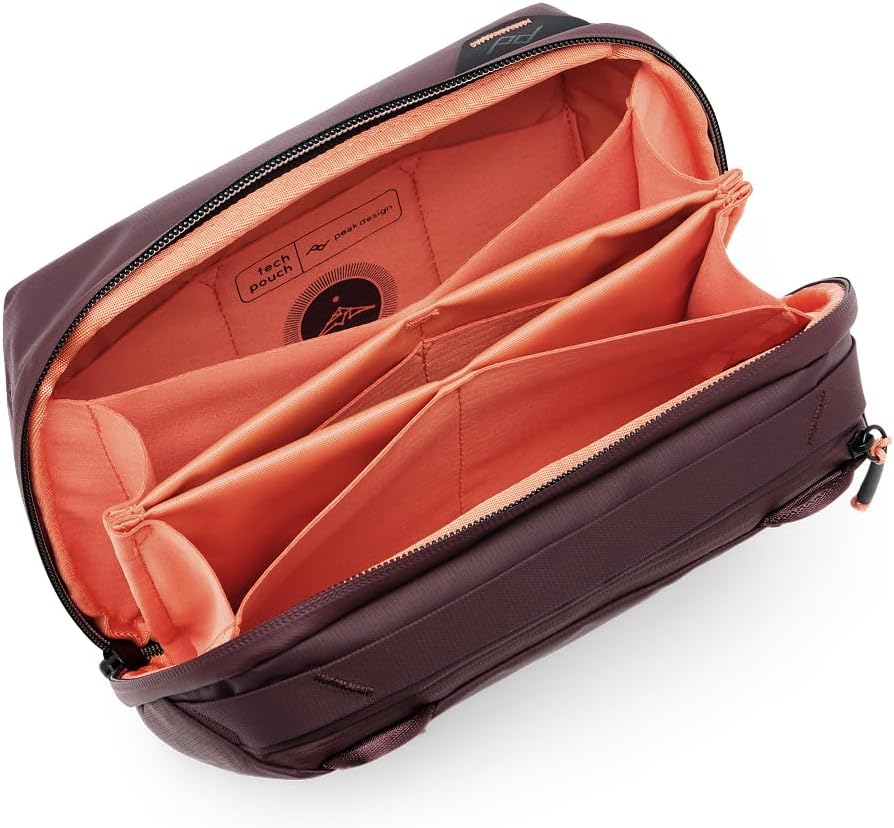
Peak Design understands the difference between storage and organization, and that is why the Tech Pouch Small works so well. The internal layout helps items stand up and separate naturally instead of collapsing into each other. That means chargers are easier to grab, cables are less likely to tangle, and smaller accessories stop disappearing into dark corners. For travel, those details matter because they shorten every interaction with your bag.
The “Small” part is important. The full-size version is excellent for some users, but I think the smaller model is the better default for daily carry and travel. It forces better selection. You can fit a compact wall charger, a power bank, a cable or two, adapters, and a few small extras without tipping into excess. That keeps the pouch useful over the long term.
Peak Design also gets the rhythm of opening and closing a pouch right. Some organizers have plenty of pockets but awkward access, which defeats the point. The Small Tech Pouch gives you visibility quickly, and that speed matters when you are standing beside a gate seat or leaning over a tray table trying to grab one cable without spilling everything else.
Pros
- Excellent internal structure and visibility
- Strong all-around size for travel
- Premium build with a polished feel
Cons
- Costs more than basic organizers
- Still a little rigid for ultra-light packers
- Can tempt you to carry one more thing than necessary
Best for Slim Bags: Bellroy Tech Kit Compact
The Bellroy Tech Kit Compact is what I recommend when someone says, “I want organization, but I hate bulky pouches.” It is clean, restrained, and intentionally limited in a good way. You can fit the essentials, but not a whole drawer’s worth of extras. In practice, that makes it ideal for slimmer backpacks, tote bags, and everyday office carry.
Bellroy’s design language also tends to feel calm rather than tactical, which makes this pouch fit well in professional environments. It looks like a considered accessory instead of an outdoor surplus item. For many readers, that matters more than maxing out internal elasticity.
That softer visual profile is not trivial if your bag has to move between work and travel. The best travel gear often succeeds because it does not announce itself too loudly. Bellroy is especially good at making functional products that still look appropriate in office settings, client meetings, and cleaner commuter setups.
Pros
- Excellent choice for sleek everyday bags
- Encourages a disciplined packing list
- Looks refined in work or travel settings
Cons
- Capacity is intentionally limited
- Not the right pouch for larger battery packs
- Premium pricing for a compact organizer
Best Budget Buy: Tomtoc Electronics Organizer
Budget pouches often fail in one of two ways: flimsy materials or lazy internal layouts. The Tomtoc Electronics Organizer avoids both well enough to earn a recommendation. It does not feel luxurious, but it feels competent. The layout supports common travel accessories, the zipper action is decent, and the overall value is strong for buyers who want more order without spending premium-brand money.
I especially like this for occasional travelers and readers building a first real tech kit. You can buy a Tomtoc, fill it with a good cable, compact charger, and battery pack, and suddenly your bag feels more intentional. That is a bigger quality-of-life improvement than many more expensive accessories provide.
Budget gear tends to disappoint when it cuts corners on the exact parts you touch every day. Tomtoc avoids the worst version of that problem. It may not delight you the way a premium pouch can, but it does enough right that most buyers will feel organized instead of compromised.
Pros
- Very good utility for the price
- Enough structure for common travel tech
- A smart first organizer for most people
Cons
- Materials are solid rather than premium
- Does not feel as refined as Bellroy or Peak Design
- Long-term durability is less confidence-inspiring than top-tier options
Best Minimalist Pouch: Aer Slim Pouch
Aer products tend to make sense for users who want sharp, structured gear that disappears into a larger system. The Slim Pouch follows that pattern. It is not a maximal organizer. It is a disciplined one. If your carry kit is already pared down to a charger, cable, earbuds, and maybe a compact battery, this form factor feels excellent.
The Aer is also a nice fit for commuters who use the same bag across office days and short trips. It keeps the visual profile neat, and it resists the creeping sprawl that hits larger pouches over time. For readers who value restraint, that is a bigger benefit than another elastic pocket.
Pros
- Very clean size and silhouette
- Excellent for already-curated carry kits
- Works well for commuters and office-friendly bags
Cons
- Limited room for larger chargers or adapters
- Not ideal if you carry category overlap
- Less forgiving than roomier organizers
Best Modular Premium Pick: Orbitkey 2-in-1 Tech Accessory Pouch
The Orbitkey 2-in-1 pouch is a smart choice for readers whose gear shifts between home office, backpack, and travel often. It feels designed around movement. Instead of just storing items, it helps segment them in a way that supports reconfiguration. That can sound abstract until you live with it for a week and notice how much faster it becomes to move your essentials between setups.
It is still a premium pouch, so this is not the bargain recommendation. But it is one of the more thoughtful options if you value modularity and cleaner transitions between environments. It also pairs naturally with the lighter, more intentional EDC setup in our ultimate tech loadout guide.
Pros
- Thoughtful format for mixed desk-and-travel use
- Premium feel and good structure
- Helps separate gear cleanly without much clutter
Cons
- Expensive
- More compelling for frequent movers than casual users
- Still not ideal for oversized chargers and hard drives
How we tested
I looked at these pouches in the context that matters most: repeated daily access. That means pulling chargers and cables in and out of backpacks, opening the pouch in cramped spaces, packing it into personal-item bags, and seeing whether the internal layout stayed helpful after a week instead of only on day one. I paid attention to zipper quality, shape retention, item visibility, and whether a pouch made it easier or harder to keep a disciplined travel kit.
The best organizers did not just hold gear. They improved the rhythm of using it.
Another detail that mattered was whether a pouch encouraged clean packing or lazy packing. Good layouts naturally guide cables, adapters, and batteries into sensible spots. Bad layouts let everything drift into the center. Over several days of travel, that difference becomes very obvious.
Buying guide: choosing the right organizer
Start by laying out what you actually carry. If the list includes one charger, two cables, earbuds, and a battery pack, you probably want a smaller pouch than you think. Oversized organizers feel useful in theory but often become catch-all bins in practice. Buy the smallest pouch that comfortably fits your real setup.
Next, think about the bag the pouch lives in. A highly structured organizer can be great in a roomy backpack, but too bulky in a slim tote or messenger. Conversely, a soft minimalist pouch can disappear nicely into a tight bag but make item retrieval slightly slower. The right answer depends on whether your broader carry system favors rigidity or flexibility.
Finally, match the organizer to your device mix. If you carry laptop accessories and larger power bricks, prioritize shape efficiency and access. If your kit is mostly phone gear, smaller and flatter pouches usually feel better. If you still need to optimize the gear inside the pouch, our guides to portable chargers and USB-C cables are the logical next stops.
One final tip: pack your organizer for the seat, not just the bag. If you often pull it out on planes or trains, you want a pouch that opens cleanly in tight spaces and does not require a full table spread to access one adapter. That small-use scenario reveals a lot about which designs are truly travel-ready.
FAQ
What should go in a tech organizer pouch?
Usually a charger, one or two cables, a power bank, adapters, earbuds, and small accessories like SIM tools or SD cards. If the pouch contains items you never use, it is probably too big.
Is a hard-shell organizer better than a soft one?
Not always. Structured pouches improve visibility and protection, while softer pouches can pack down more easily. The better option depends on your bag and how fragile your gear is.
Are premium pouches worth the money?
Sometimes. Premium models often justify their price with better layout, materials, and long-term usability. But budget organizers can still deliver most of the convenience if your needs are simple.
How do I stop my organizer from becoming cluttered?
Reduce duplicate cables and accessories, and choose a pouch that limits overpacking. Smaller organizers often create better habits than larger ones.