By Daily Carry Lab. Primary documentation checked October 14, 2026 (Pacific).
Affiliate disclosure: As an Amazon Associate, Daily Carry Lab earns from qualifying purchases. Retailer links may earn a commission at no extra cost to you. Manufacturer links support the documented claims.
Research disclosure: We have not tested these products. Selection is based on primary documentation and the compatibility decisions below; no DCL ratings or measured performance are claimed.
For wired headphones on a USB-C phone, the first question is whether the complete audio path works, including any microphone you need. Apple MW2Q3AM/A is a documented option for the Apple devices listed on its compatibility page. FiiO KA11 USB-C is a listening-oriented alternative whose manufacturer explicitly says it does not support wired headset microphones. These are two documented choices, not a sound-quality ranking.
We selected an Apple adapter with an exact regional part number and a separately documented DAC/headphone-amplifier family. Neither a retailer’s broad compatibility title nor a large audio-format number establishes that calls, controls and playback all work on your phone.
Match the USB connector to the actual phone
Apple describes its adapter as connecting a standard 3.5 mm audio plug, such as headphones or speakers, to USB-C devices. Its current compatibility list includes the iPhone 15 family, iPhone 16 family and multiple USB-C iPads and Macs. Check your exact model on that list instead of extending the statement to every Android phone or every device with a USB-C socket. Apple MW2Q3AM/A product and compatibility page.
For KA11, this guide’s retailer identity is the silver USB-C/TC variant, B0CS62JGW2, whose model field reads KA11 TC. Other KA11 listings use Lightning/LT. Verify the selected input connector; the family name alone does not prevent buying the wrong one. We have not established universal phone or console support for this exact variant.
Separate listening from headset input
FiiO’s KA11 FAQ says wired microphones are unsupported. It describes using the phone’s own microphone while hearing a call through headphones. That is a material drawback if your plan depends on a wired headset mic, such as a quiet call with the phone kept in a pocket. Do not assume that an adapter accepting a 3.5 mm plug necessarily accepts the microphone contact on a four-contact headset. FiiO microphone FAQ.
The captured Apple product page establishes the audio connection and listed host devices. We have not established a universal microphone and inline-button matrix from that page, so we do not promise every headset control on every phone or app. If calls are essential, verify the exact headset, adapter and host combination before buying and make a call before a trip. Playback alone does not complete that check.
| Requirement | Apple MW2Q3AM/A | FiiO KA11 USB-C/TC |
|---|---|---|
| Physical path | USB-C host to standard 3.5 mm audio plug | Exact captured retailer variant is USB-C to 3.5 mm |
| Primary host evidence | Apple’s explicit device compatibility list | Exact host/OS matrix not established in this guide |
| Wired headset microphone | Exact headset/app behavior still needs confirmation | Manufacturer says unsupported |
| Inline remote controls | Exact control behavior not established here | No inline-control guarantee established here |
| Manufacturer describes DAC/amplifier | Not specified in the captured product page | DAC and headphone amplifier in FiiO announcement |
Sources: Apple, FiiO microphone FAQ, FiiO KA11 announcement. The KA11 connector variant is separately verified in the retailer ledger; retailer specifications do not substitute for missing primary OS evidence.
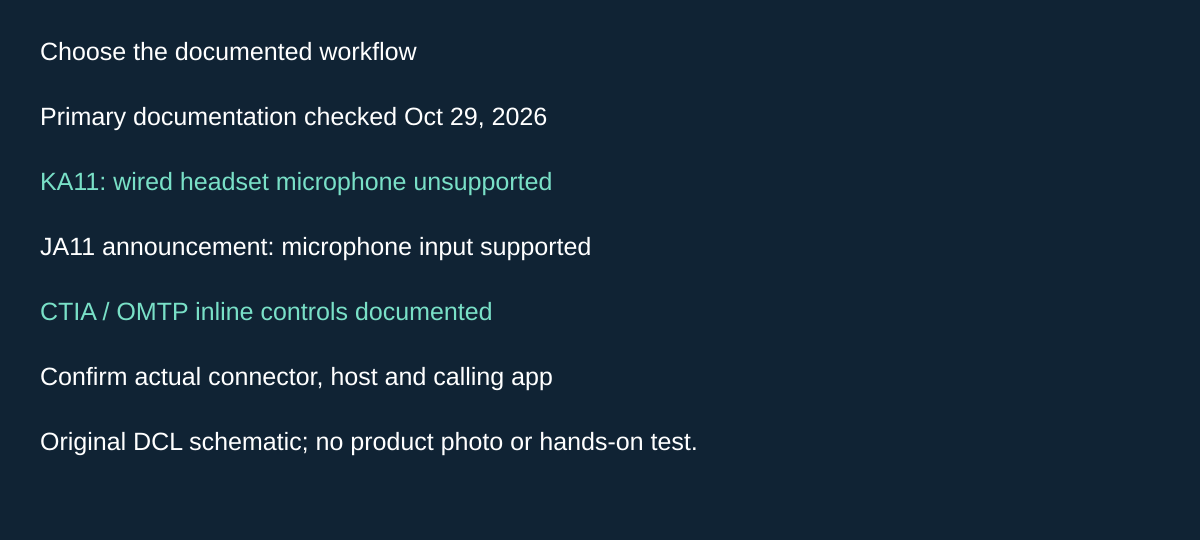
Original DCL research schematic, October 29, 2026; documented choices, not a product photograph or DCL test.
JA11 supplies a documented microphone alternative to the KA11 limitation
The KA11 microphone limitation is a reason to compare a different adapter, rather than choose by its audio-resolution headline. FIIO’s JA11 announcement, read October 29, 2026, explicitly documents microphone input and CTIA/OMTP inline controls. That makes JA11 a candidate to investigate when you want to retain an analog headset microphone. It is not proof that every headset control works with every host or calling application.
| Intended use | Documented difference | Remaining purchase check |
|---|---|---|
| Hear music through analog headphones | Existing Apple/KA11 routes above remain relevant | Select the supported exact host and connector |
| Use a wired headset’s microphone | JA11 announcement supplies input evidence absent for KA11 | Verify headset wiring, host and recording/calling app together |
| Keep every inline remote function | FIIO names CTIA/OMTP inline controls | Confirm the specific buttons you need; no universal matrix established |
| Buy a USB-C accessory for the trip | Match the actual offer’s input connector and model | This announcement extract does not establish a regional SKU or retailer identity |
We add JA11 for the microphone function, without claiming a sound-quality improvement over KA11 or the Apple adapter. The manufacturer’s announcement also discusses audio processing, but those features are not a substitute for a confirmed voice path. Do not assume the JA11 inherits KA11’s documented Android mode-switching procedure above; each model requires its own setup evidence.
A useful pre-trip check is to make a disposable voice recording and a short call using the intended headset, adapter and app. Confirm which microphone the application uses and exercise the controls you actually need. Hearing playback is insufficient to establish that the headset microphone is active. This is a proposed owner check; DCL has not performed it or measured microphone quality.
Budget and limitation: current complete-kit prices are unknown. The announcement contains a dated launch promotion, which we do not treat as a current offer. No JA11 retailer or USB-C variant is approved by this section; obtain exact-connector and host confirmation before ordering. Existing compatible equipment may avoid a purchase, and simultaneous charging remains a separately unverified arrangement.
An active DAC and a passive adapter have different prerequisites
FiiO explicitly describes KA11 as a DAC and headphone amplifier. Its announcement also mentions UAC 1.0 mode and app control. That does not establish that every app, operating-system version or game console exposes every feature. We have not verified an exact mode-switching workflow for each host and make no driver-free universal compatibility claim.
A passive analog adapter and a USB audio device require different host support. Do not buy a passive adapter merely because it looks like the same USB-C-to-3.5 mm shape. Ask the phone maker which audio path its port supports and match the accessory’s own documentation. This distinction is a compatibility check, not an audible-quality conclusion. We do not infer Apple’s internal DAC specification from connector shape.
Check power, fit and the complete call workflow
Both compared accessories occupy the phone’s USB-C port in the simple connection shown here. This guide does not establish charging passthrough, a second charging socket or simultaneous charging through an added splitter. If you need a long call while charging, choose and verify that complete arrangement separately rather than assuming any USB-C hub supports headset audio and microphone input.
Check that the plug seats fully with your phone case installed. Route the short adapter and headphone cable without pulling sideways on the port. We have not measured case clearance, cable strain or durability; these are setup checks to perform with the exact kit.
| Choice | Budget status checked October 14, 2026 | Useful reason | Drawback |
|---|---|---|---|
| Apple MW2Q3AM/A | Current checkout total unknown | Listed Apple-host audio connection | Do not extend support to unlisted hosts or every inline control |
| KA11 TC silver | Current checkout total unknown | Documented DAC/headphone-amplifier family | No wired headset mic; exact host/features still need verification |
| Existing suitable adapter or built-in jack | No new adapter purchase if it works | Resolve playback and calls with your current kit first | Ownership alone does not establish compatibility with a new phone |
Retailer identities checked October 14 are Apple MW2Q3AM/A B0D7FF5Y3X and FiiO KA11 TC silver B0CS62JGW2. No stock, price, photograph permission or measured output advantage is claimed. If wireless playback is the better fit, our travel over-ear headphone guide examines that separate decision. For this wired path, choose only after the host, microphone and charging workflow are clear.
iPhone Duo: direct USB-C EarPods or keep your analog headphones?
Added research checked October 23, 2026. An adapter is unnecessary if you choose headphones that already provide the documented USB-C connection. Apple’s US EarPods USB-C page, MYQY3AM/A explicitly lists iPhone Duo. It requires USB-C iPhones running iOS 17 or later and describes a remote for volume, playback and answering or ending calls. Its box contains USB-C EarPods. This is compatibility evidence, not DCL sound, comfort or microphone testing.
| What you already own or need | First route to evaluate | Drawback or verification |
|---|---|---|
| Analog headphones you want to keep | Exact compatible USB-C-to-3.5 mm adapter | Keep the headset microphone/remote checks above; Duo EarPods evidence does not certify other adapters |
| A complete wired headset without a separate analog adapter | Exact MYQY3AM/A USB-C EarPods | Different fit and sound from your existing headphones; no subjective ranking established |
| Headset calls while charging from the same port | A separately documented complete audio-and-power arrangement | No splitter or hub is qualified by this EarPods page |
| Listening through KA11 while relying on a headset mic | Reconsider the microphone path before purchase | Existing manufacturer microphone limitation remains; no Duo exception inferred |
Apple’s USB-C connection guidance distinguishes direct USB-C headphones from the 3.5 mm adapter route. Choose by the headset you want to retain and the call workflow you need. A direct USB-C plug occupies the port in the simple arrangement here; do not buy an extra DAC simply because the phone has no 3.5 mm socket. Conversely, a new headset need not replace an analog pair whose complete supported path already works.
| Budget decision | Dated evidence | Remaining cost or drawback |
|---|---|---|
| US USB-C EarPods MYQY3AM/A | Apple displayed $19 before tax on October 23, 2026 | Tax/shipping and return terms need checkout; no stock claim |
| Keep suitable existing headphones and adapter | No new equipment if the complete kit is already owned and supported | A missing or incompatible adapter changes that calculation |
| Buy an adapter for existing analog headphones | Exact current checkout total unknown here | Include all required pieces, not only the adapter’s advertised price |
Confirm the USB-C selected variant: Lightning and 3.5 mm EarPods are different connection choices. Test your actual calling app, remote operations and case clearance before relying on the kit for a trip. We have not established a measured microphone advantage or universal third-party-host compatibility. This update adds a direct-headset alternative to the existing adapter decision, with primary links only and no new retailer mapping.
Check Android setup access before buying KA11 for UAC 1.0
The earlier UAC capability statement needs a setup check before purchase. FIIO Japan’s KA11 Type-C specification, checked October 25, 2026, documents UAC 2.0 and UAC 1.0 and says switching to UAC 1.0 requires FIIO Control for Android. The Japanese-language page names Nintendo Switch and PlayStation 5 in its UAC 1.0 description. We do not convert that statement into a universal console or revision guarantee.
| Purchase plan | Resolve first | Drawback |
|---|---|---|
| Need UAC 1.0 | Access to a supported Android device and FIIO Control setup | Owning only an iPhone does not establish access to that documented switching method |
| Move between hosts | Confirm the required mode and current exact-host support | Two supported modes do not promise automatic switching |
| Use a wired headset for voice chat | Retain the manufacturer microphone limitation above | UAC selection does not establish headset-mic input |
This regional Type-C documentation does not approve another retailer variant, Lightning version or third-party switching utility. No firmware change is prescribed here.
Budget: current adapter and setup-device costs are unknown. Resolve configuration access before buying for this feature; a compatible adapter already owned may suffice. DCL has not tested console audio, mode persistence or switching reliability.
Shop the researched models
These Amazon links are affiliate links. Daily Carry Lab may earn a commission from qualifying purchases. Match the model and included contents to your needs; this guide is based on manufacturer-source research, without hands-on testing.
-
Apple USB-C to 3.5 mm Adapter (MW2Q3AM/A)
Check Apple USB-C to 3.5 mm Adapter (MW2Q3AM/A) on Amazon -
FiiO KA11 USB-C (silver)
Check FiiO KA11 USB-C (silver) on Amazon
Sources and limits
This guide compares published specifications and source documentation. Daily Carry Lab has not performed hands-on tests of the products in this guide. Consult the dated sources and verify the exact model and current terms before buying.
Related guides
iPhone 18 Pro: Wrist Strap or Crossbody Strap, with the right case
Compare exact Apple Wrist and Crossbody strap packages for iPhone 18 Pro by attachment, length, complete cost and limitations.
Portable label makers: choose phone control or a built-in keyboard
Compare Brother PT-P300BT CUBE and PT-H110 by phone dependence, TZe tape widths, power and cable-label workflow.
Travel AA/AAA chargers: match the cells, slots and USB input
Compare four-slot AA/AAA charging systems by exact chemistry and USB input. Includes conditional XTAR BC4 research and explicit operating-manual limits.
USB-C bike front lights: compare modes, mounts and charging
Compare Lezyne Micro Drive 800+ and Fenix BC15R using exact modes, rated runtime, battery design and mounting limits, without road-certification claims.